
CATEGORY GUIDE 7 min read
Small Closet Organizers: How Retail Buyers Can Choose Rails, Hooks and Bins
Source small closet organizers with confidence. Compare rails, hooks and bins, check cabinet fit, and plan samples and packaging for your retail range.
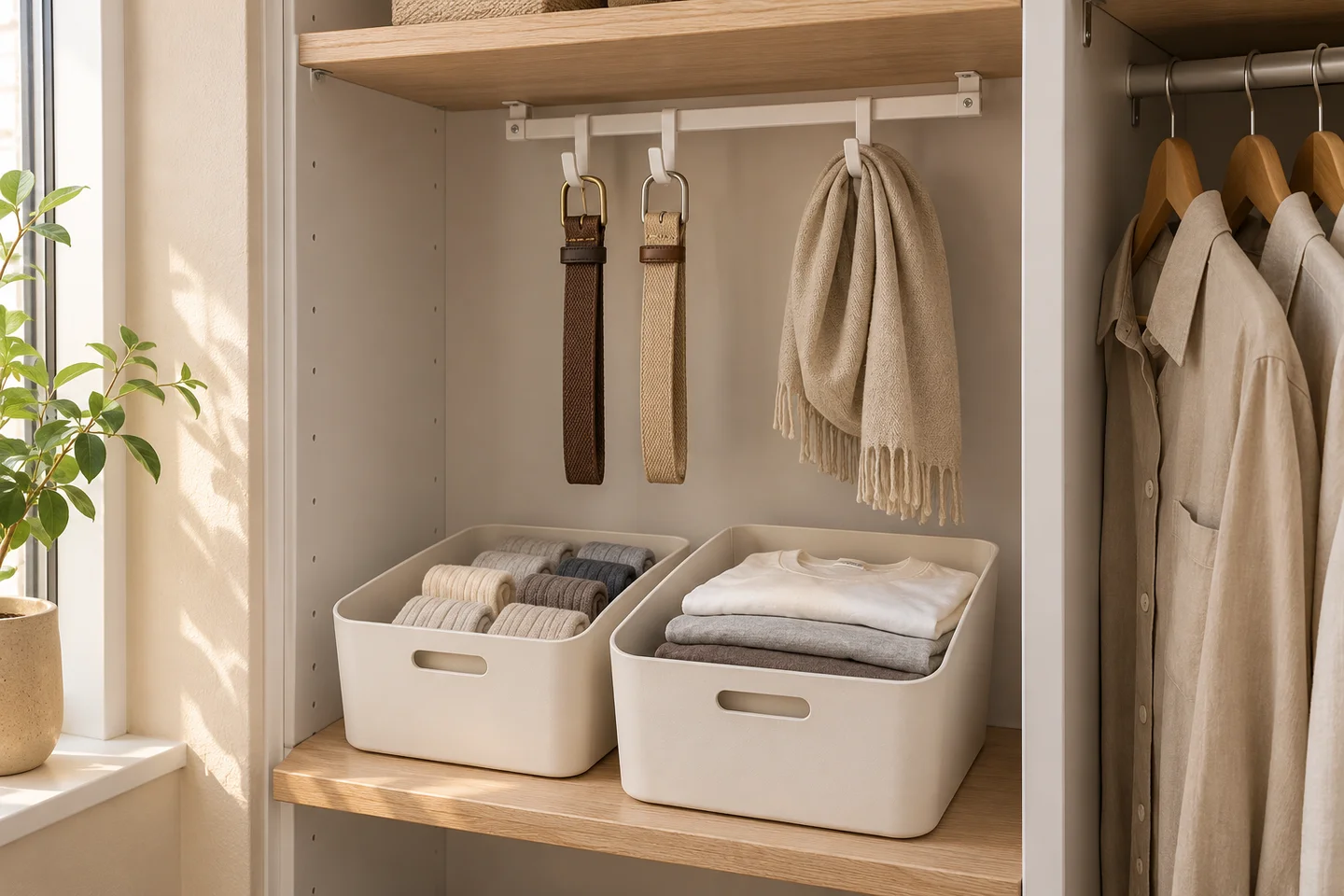
AI-generated lifestyle illustration. The organizers shown are generic concepts, not exact HAKORA products.
The most useful small closet organizers fit the cabinet, hold a clearly defined group of items and leave enough room for everyday access. For retailers, that means checking more than the product's listed dimensions. A bin can fit on a shelf yet be awkward to lift out; a sliding rail can fit inside a cabinet yet collide with the door when extended.
Build your assortment around three tasks: separating folded items, hanging accessories and retrieving items from deeper spaces. Then approve samples against the furniture dimensions and installation conditions your customers are likely to encounter.
Start with the storage task
A small wardrobe may contain several different storage problems. Socks become mixed on a deep shelf. Belts collect underneath folded clothes. A narrow side panel offers space, but only if an accessory can attach securely without obstructing hanging garments.
Choose a primary task for each SKU. An open bin can group folded items; a hook can keep an accessory visible; a sliding format can bring stored items toward the user. Describe that task on the packaging and show it in a realistic cabinet setting.
Avoid presenting every organizer as suitable for every room. A shopper should be able to see what belongs inside it, where it goes and how to use it.
Compare rails, hooks and bins by access
| Format | Potential assortment role | What buyers should check |
|---|---|---|
| Sliding rail organizer | Bring accessories or separated small garments toward the cabinet opening | Installed footprint, travel distance, mounting method and clearance from doors |
| Sliding hook organizer | Give belts, scarves or similar accessories a defined place | Hook spacing, usable hanging length, snag points and compatibility with the intended items |
| Open shelf bin | Group socks, folded clothing or accessories by type | Usable interior dimensions, grip access and room to remove the bin |
| Wall-mounted bin | Use a suitable side or wall surface for small items | Approved surface, fixing method, installed depth and supported load |
These formats need different sample checks. A removable bin depends on the handhold and the space around it. A mounted organizer also depends on the cabinet surface and the supplied fixings. Assess both the product and the setting in which it will be used.
Explore HAKORA's wall and closet organizer family when comparing rail, hook and wall-storage formats.
Measure the cabinet and the movement
Ask for a dimensioned drawing that distinguishes the product body from its installed footprint. For a moving organizer, request the dimensions in both the closed and fully extended positions.
Record the following before approving a format:
- The clear opening between the cabinet door and opposite frame.
- The usable width and depth after allowing for hinges and shelf supports.
- The shelf thickness or panel construction required by the mounting system.
- The space needed to extend, lift or remove the organizer.
- The remaining clearance once garments or accessories are loaded.
For example, a nominally 40 cm deep cabinet does not automatically accommodate a 38 cm organizer. A rear panel, door hardware, mounting bracket or required operating gap may reduce the usable space. Treat this as a fit question to resolve with a drawing and sample, rather than a universal sizing rule.
For bins, check interior dimensions as well as exterior dimensions. Tapered sides, rounded corners and handles can reduce the usable space. Photograph the sample with representative items so the retail team can assess capacity without relying on a volume claim alone.
Use catalog references to build a shortlist
HAKORA's published catalog groups sliding rails and sliding double hooks within its wall and closet organizer family. These references provide a starting point for a sample request:
| Catalog reference | Listed format | Listed material | Listed product size |
|---|---|---|---|
| 5561 / 5661 | Underwear sliding rail | ABS | 38 × 28.5 × 5 cm |
| 5562 / 5662 | Sliding double hook | ABS | 38 × 7 × 6.7 cm |
These are catalog product dimensions, not confirmed installation clearances or extension distances. Ask HAKORA to confirm the current SKU, color, fixing method and operating dimensions for the sample you intend to buy. The related reference numbers should not be treated as interchangeable without confirmation.
For shelf-bin options, review the separate drawer and cabinet organizer range. Select a suitable format by dimensions and intended use; do not assume products from different families form a compatible system.
Plan an assortment with a clear role for each SKU
A useful starting assortment might combine one format for folded items, one for hanging accessories and one for bringing items forward. The exact mix should follow your customer, shelf space and price positioning.
Differentiate additional SKUs by a meaningful change: a narrower footprint, a different access method or a distinct storage task. Adding several near-identical sizes can make selection harder unless the packaging clearly explains which cabinet or contents each size suits.
For online listings, show the product alone, installed in a cabinet and in use. Include a dimension drawing and an image of the supplied components. Keep styling props separate from the items included in the pack.
Approve samples through everyday use
Set acceptance criteria before placing an order. Use representative garments and accessories, then repeat the actions a customer would perform: loading, reaching, sliding, removing and resetting.
Check for rough edges around handholds and hooks. Observe whether fabric catches, whether the organizer interferes with adjacent items and whether any moving component becomes difficult to operate under the agreed test conditions.
For mounted products, follow the proposed instructions on a representative cabinet surface. Confirm the fixing type, panel requirements, tools and any installation restrictions. A successful demonstration on one surface does not establish suitability for other surfaces.
Request load and durability evidence appropriate to your intended claims. Material names alone do not establish a safe working load, resistance to repeated use or suitability for every installation. Record the agreed conditions alongside the approved sample.
Make packaging answer the fit questions
Packaging should help the customer decide whether the organizer suits their wardrobe before purchase. Show the overall dimensions, installation method, required clearances and included components. If a rail moves, make the open position easy to understand.
Confirm whether fixings are included and identify any restrictions on the mounting surface. Use wording such as "tool-free" or "no drilling" only when it accurately describes the approved product and installation method.
For freight planning, compare packed dimensions and carton quantities alongside unit price. Ask whether parts nest, detach or require protective packing, and review a packed sample. A compact product does not necessarily have a compact shipping carton.
If you are developing your own packaging or coordinated range, HAKORA's OEM and ODM page provides a route for discussing the brief.
What to include in a supplier inquiry
A useful inquiry names the storage task and includes a cabinet sketch or photos with measurements. Add your target market, sales channel, preferred formats, initial order estimate, packaging requirements and sample expectations.
For rails and hooks, ask about mounting and movement before finalizing the retail presentation. For bins, identify the items customers will store and how they will remove the container. These details give the supplier a practical basis for recommending a shortlist.
Frequently asked questions
Which small closet organizers should a retailer stock first?
Start with the tasks your customers need to solve. Open bins suit grouping folded items, hooks provide a place for accessories, and sliding formats may help with retrieval. Choose a small initial range whose fit requirements and uses are easy to explain.
Does a listed product size tell me whether it will fit?
It gives a starting point. Confirm the installed footprint, cabinet opening, fixing space and operating clearance. Moving parts and loaded contents may require additional room beyond the product body.
Can sliding hooks be sold as no-drill organizers?
Only when the specific product uses an approved no-drill installation method. Confirm the fixing system, suitable surfaces and instructions before making that claim.
Can rails and bins be sold together as a set?
They can be considered for a coordinated assortment, but check their combined footprint, access and packaging. Complementary use does not mean the products physically connect or fit every cabinet together.
Discuss your closet organizer range with HAKORA
Share your cabinet dimensions, preferred rail, hook or bin formats, target market and packaging plan. HAKORA can review the requirements and discuss relevant catalog references and sample questions with your team.