
OEM & ODM 12 min read
How to Build a Private-Label Home Organization Collection: From Product Brief to Shipment Inspection
Plan a private-label home organization collection with a practical OEM guide covering product briefs, sample approval, packaging, quality checks and shipment inspection.
Introduction
Private-label home organization can be attractive because the category invites repeatable, coordinated collections. A consumer who buys a pantry bin may also need a fridge organizer, drawer tray, cabinet basket, closet box or wall-storage accessory. For the buyer, that creates a chance to build a recognizable range rather than compete with disconnected single products.
It also creates complexity. A collection must work across consumer use, retail shelf logic, dimensions, color, packaging, product photography and replenishment. A supplier cannot reliably quote or develop that system from a single inspiration photo. The project needs a commercial brief that tells the manufacturing team what the collection is for, which details are fixed, and where technical guidance is still needed.
This guide explains a practical sequence for brands, importers, retailers and distributors developing OEM home storage products. It uses clear approval gates rather than promises of universal quality or fixed delivery outcomes. Your final specification should always reflect the actual product, supplier, target market and agreed validation plan.
1. Define the collection promise before choosing SKUs
The first step is deciding what the collection will help the shopper accomplish. “Home organization” is broad. A clear retail promise gives the range a reason to exist and helps avoid a catalog that simply repeats what competitors already sell.
Choose a primary organizing world
A focused starting point may be:
- Kitchen and pantry: containers, shelf bins, fridge organizers, drawer trays and cabinet accessories.
- Closet and bedroom: lidded boxes, foldable storage, drawer organization and garment-related accessories.
- Bathroom and laundry: countertop organizers, shelf bins, utility storage and smaller sorting formats.
- Everyday flexible storage: modular bins and boxes that can move between rooms.
The collection can later expand, but the first group should share a recognizable logic. For example, a pantry-focused range might be organized by access and visibility, while a closet-focused range may prioritize stacking, labels and seasonal storage. If every SKU attempts to solve every room, the shopper has less reason to understand the system.
Write the shopper-facing proposition in one sentence
Before development, write one sentence that the retail team could use: “A modular range that makes pantry shelves easier to see and reset,” or “A calm, coordinated storage system for closet and laundry routines.” This is not final advertising copy. It is a decision filter. It helps the buyer decide whether a new SKU, finish or packaging idea belongs in the collection.
2. Build a SKU architecture that is useful at shelf level
In a private-label range, individual product decisions affect each other. A large bin needs to sit beside a medium version; a lid should look intentional with the body; a drawer tray may need to align visually with a countertop organizer. The buyer should map this before requesting final pricing.
Create a range matrix
For each proposed SKU, list:
- Product name and intended room.
- Consumer problem solved.
- External and, where relevant, interior dimensions.
- Primary material direction and finish target.
- Open-top, lidded, divided, nested or stackable behavior.
- Key components and color reference.
- Retail-pack format and consumer set quantity.
- Proposed product image or merchandising role.
This matrix is not bureaucracy. It shows gaps and duplication. It may reveal that two sizes are too close to justify separate shelf space, that a matching lid has not been defined, or that an item cannot fit the intended retail fixture. It also gives the OEM partner a structured place to flag questions before tooling or sampling decisions become expensive.
Design a recognizable rhythm
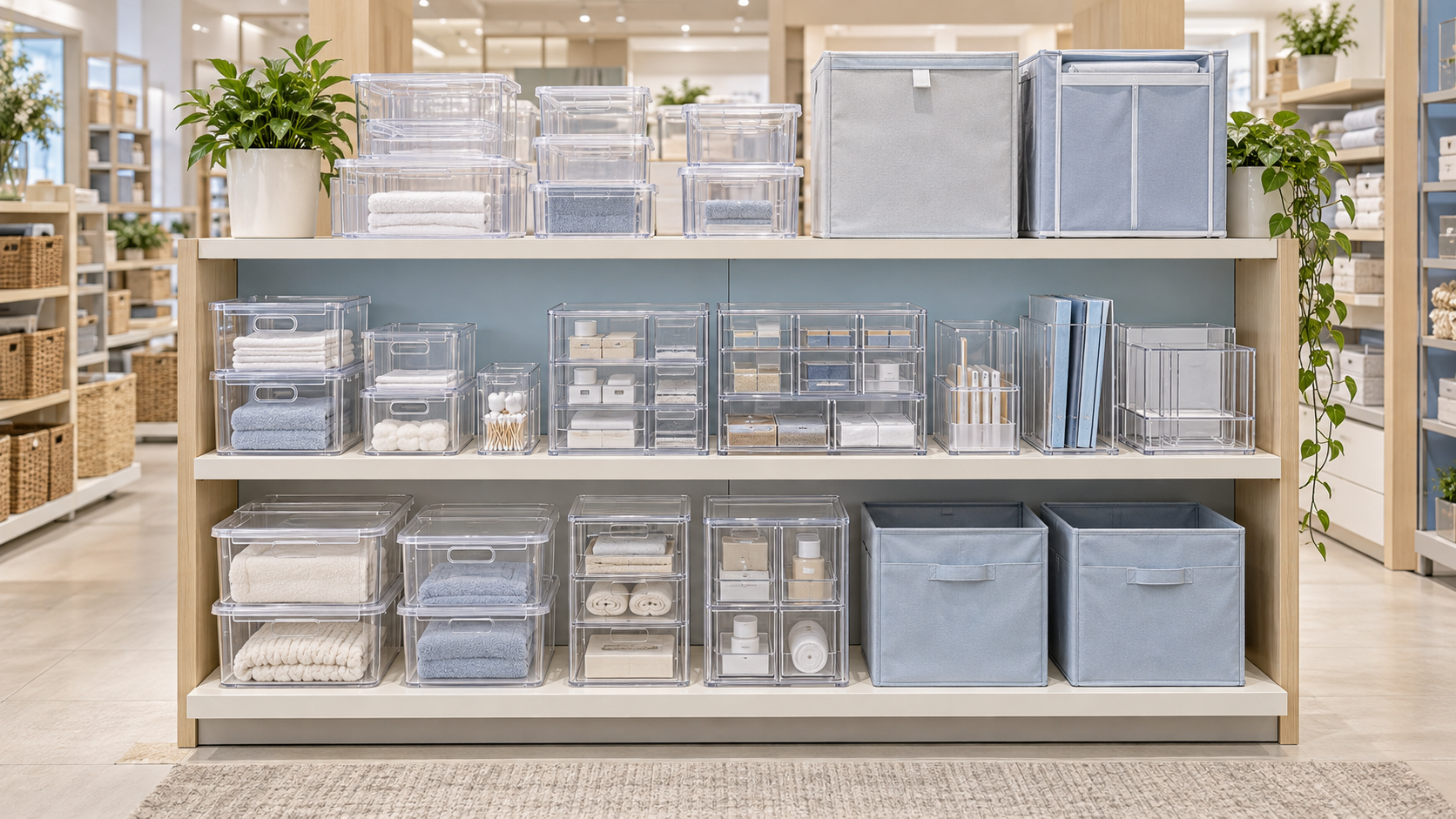
Ranges feel more premium when repeated decisions are deliberate. Consider a small family of compatible widths or lengths, a progression of heights, consistent handle style, a controlled color palette, related label zones and product names that explain function. This does not require every item to have the same material or exact shape. It means the differences should be purposeful.
During product application review, lay several sample SKUs together as they would appear on shelf or in an e-commerce image. This is often where disproportionate handles, inconsistent color, awkward visual gaps or duplicated product roles become visible.
3. Create an OEM brief that a supplier can act on
An effective OEM brief contains a mix of fixed requirements and open questions. The supplier needs to know where it can recommend a solution and where it must follow an exact reference.
Essential contents of the brief
Business context: identify the retail channel, target market, approximate launch window, product position and whether the program is an individual SKU, set or collection.
Product use: explain where the item will be used, what it will hold, how it will be accessed and what a successful consumer experience looks like.
References: include sketches, reference photos, mood boards, competitor examples or existing products. Clearly label what is only visual inspiration and what is a required feature.
Dimensions: list critical external and internal measurements. If a dimension must fit a shelf, drawer, box or existing accessory, say so explicitly.
Materials and finish: describe the desired visual effect, color standard, texture, transparency or opacity. Ask the supplier to identify the proposed material by component.
Packaging and labels: state the consumer-set quantity, retail-pack preference, barcode location, required country-of-origin or warning marks, carton requirements and artwork approval path.
Validation: state which samples, documents, inspections or destination-market checks must be completed before production approval.
Avoid two unhelpful extremes
One extreme is an overly vague brief: “We need stylish storage boxes at a good price.” The other is a highly detailed drawing that leaves no room for technical discussion but has not been validated for manufacturing or use. A good brief is specific about the shopper problem and commercial constraints while inviting the supplier to ask questions about construction, materials and process.
4. Use samples to make decisions, not simply to approve appearance
Sample approval is the moment when strategy becomes a physical product. The buyer should test whether the sample does the job described in the brief—not only whether it looks good in a photo.
A practical sample-review routine
- Confirm the sample revision, product code, proposed material, color and components.
- Compare critical dimensions with the drawing or range matrix.
- Put the item in the intended setting: shelf, drawer, fridge-style zone, cabinet, closet or countertop.
- Add representative contents and use it in the normal way: lift, slide, open, nest, stack or separate items.
- Check visual appearance under ordinary light as well as the studio-style conditions used for product photography.
- Review interfaces: lid to body, bin to shelf, divider to tray, handle to adjacent product and label to pack.
- Document what is approved, what changes, and which point is still open.
For example, instead of “sample accepted,” an approval note could say: “Approve the current footprint and handle opening; change the front label zone; confirm the body color against the retained reference; provide pack-out photos before mass production.” This is a usable factory instruction and a useful record for the buyer’s quality and marketing teams.
Prepare for installation or setup where relevant
Some organization systems need more than simple unpacking. Wall-storage items, modular parts, over-door formats or products with assemblies should have an installation-preparation review. Confirm the component count, tools or fixings (if any), instructions, warning needs, packaging order and the way the consumer will understand the setup. Do not assume that a product is ready for a particular installation environment unless the product-specific requirements have been reviewed.
5. Treat packaging as part of the brand and inspection plan
Private-label packaging has two jobs: it helps a shopper understand the product and it helps a supply chain identify, protect and receive it. Both should appear in the OEM brief.
Consumer packaging
Choose a format that supports the product’s retail role. A clear organizer may need the product itself to remain visible. A multi-piece set may need a sleeve or insert that explains included components. A lidded storage product may need an information panel that distinguishes the body from the lid and makes the set quantity unmistakable.
Keep claims disciplined. Dimensions, included components, product use and care instructions are useful when accurate. Avoid unverified superlatives or broad compliance statements. If a target market requires specific labeling, seek the correct review rather than copying labels from another region.
Master cartons and receiving
The buyer should agree the master-carton count, SKU identification, carton marks, product orientation, pallet instructions and any photo requirements before shipment. Ask for a pack-out review before the first production run. This can identify poor nesting, unexpected empty space, incorrect count or label placement while changes are still possible.
If product images will be used for e-commerce, plan photography after the final approved sample rather than using an earlier development prototype. The website, packaging and delivered product should show the same features.
CTA: Send the first version of your collection brief
You do not need a finished technical package to begin a useful OEM conversation. Send HAKORA your category plan, target market, rough SKU list and reference images. We can help identify the information needed for a clearer product-development discussion. [Send Your Requirements → /contact]
6. Define quality expectations before the order ships
Quality control is most useful when it verifies a shared standard. It cannot rescue requirements that were never agreed. Before production, align the approved sample, drawings, product description, retail artwork, carton marks and inspection checklist.
What a shipment inspection checklist can include
- Product identity, revision and set contents.
- Critical dimensions and fit points identified in the brief.
- Visible appearance, color or finish against the approved reference.
- Assembly of lids, handles, dividers or other components.
- Packaging material, consumer-pack accuracy, barcode placement and artwork version.
- Master-carton count, carton marks, general pack-out condition and required photos.
- Any specific check defined for the product’s intended function.
Decide who performs the inspection and how findings will be reported. For a new SKU or supplier relationship, the buyer may use its own team, the supplier’s documented quality process, an independent inspection provider, or a combination. The important part is not the label on the process; it is that the criteria are clear and the final decision is recorded.
Make corrective action specific
If an issue is found, link it to a sample, photo, specification or carton reference. “Improve quality” is difficult to resolve. “Carton artwork revision does not match the approved file” or “handle opening differs from retained sample” tells the team what to check and correct.
For recurring programs, keep a version-controlled history of the product specification, sample approval, artwork and inspection feedback. This supports continuity when the range expands, when a new team member takes over, or when a repeat order is placed after several months.
7. Plan the commercial handoff after development
An OEM project is not complete at shipment. The buyer’s product, e-commerce, logistics and customer-service teams should receive the information needed to launch and support the range.
Useful handoff materials
- Final product names, SKU codes and dimensions.
- Approved product photography and a list of visible features that match the production item.
- Care information and any verified product statements.
- Packaging artwork files and barcode data.
- Carton specifications and receiving instructions.
- Product-specific documentation agreed for the target market.
- Contact route for post-shipment questions or replenishment planning.
This handoff prevents a common problem: marketing describes a feature differently from the product team, or a warehouse receives a carton with no agreed identification logic. Clear information makes the private-label range easier to sell and easier to repeat order.
8. Common OEM mistakes in home-organization projects
Building too many similar SKUs
More options are not always more useful. Start with distinct shopper problems and a purposeful size ladder. Add expansion SKUs when the collection has clear demand and merchandising space.
Sending only inspiration images
Images are valuable, but the supplier also needs intended use, dimensions, packaging direction and target-market information. Label which parts of an image are mandatory and which are only style references.
Approving a development sample as if it were final production
Keep revisions visible. A sample may be acceptable for geometry while color, pack-out or component fit still requires confirmation.
Treating packaging as an afterthought
Packaging affects visibility, product protection, consumer understanding and warehouse receiving. Bring it into the project before production—not after units are already packed.
Waiting until shipment inspection to define acceptance
Inspection is a verification stage. Define the visual, dimensional, component and pack-out expectations while there is still time to make changes.
FAQ
What is private-label home organization?
Private-label home organization refers to storage and organization products developed or sourced for sale under a retailer’s, distributor’s or brand owner’s own name. The scope can range from applying approved branding and packaging to a ready product through to a more involved OEM development project.
What should be in an OEM home storage product brief?
Include the intended consumer use, target market, reference images, critical dimensions, finish direction, component requirements, packaging format, artwork needs, required approvals and inspection expectations. Identify questions that are still open so the supplier can address them.
How can I reduce risk on a first private-label order?
Use a clear range matrix, request and review samples in the intended application, retain an approved reference, align packaging before production, and agree the shipment inspection checklist in advance. Validate destination-market requirements for the exact product rather than relying on generalized claims.
When should I ask for pack-out photos?
Before the first production shipment is finalized. Pack-out photos can help verify product protection, set count, carton arrangement, labels and the overall receiving logic.
Conclusion
The strongest private-label home-organization collections are planned like systems. They give shoppers a simple reason to buy, give retail teams a coherent story to merchandise, and give manufacturers a brief they can actually develop and inspect.
Start with the storage problems your range will solve. Build a small and connected SKU architecture. Then make sample approval, packaging and shipment inspection part of the product plan rather than separate late-stage tasks. This turns an OEM inquiry from a vague request into a workable development project.
Ready to begin a private-label storage collection? [Contact HAKORA and Send Your Requirements → /contact]